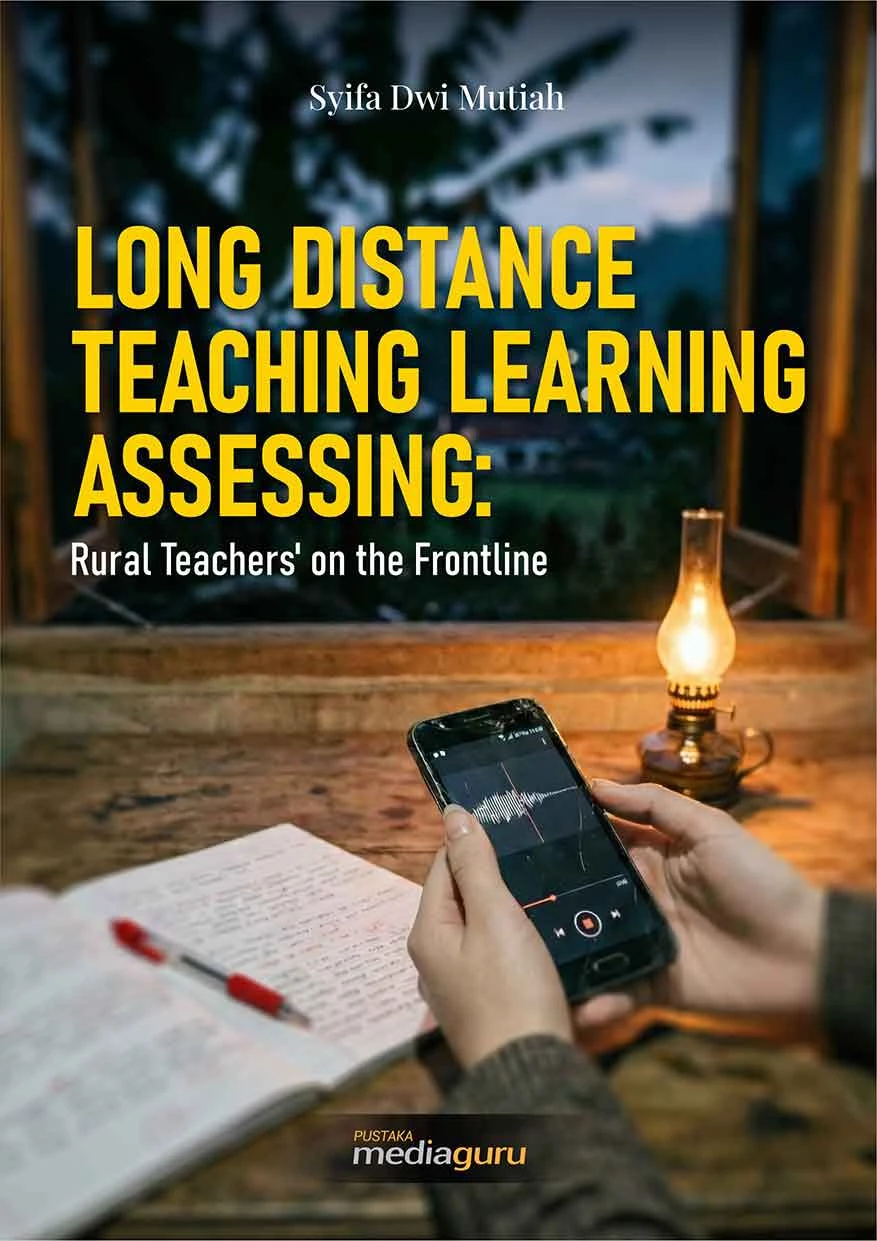
Judul:LONG DISTANCE TEACHING LEARNING ASSESSING: Rural Teachers’ on the Frontline
Editor: Nopiranti
Halaman: vi, 80 page, 14,8 x 21 cm
Cetakan: Pertama, Januari 2026
Penerbit: Pustaka Mediaguru
Anggota IKAPI No. 192/JTI/2017
Jl. Dharmawangsa 7/14 Surabaya 60286
Website: www.mediaguru.id
ISBN:
Harga:
SINOPSIS
The Covid-19 pandemic change the worldwide classrooms. It makes teachers willy nilly be ready to adapt and remote their teaching instruction almost overnight. In Indonesia, this transition created surprising inequalities between urban and rural education. This book investigates this phenomenon through English teachers experience to teach in online mode who faced extreme challenges in implementing online learning with limited infrastructure and digital literacy.
The writer explores how teachers engage with the complexities of online formative assessment in writing classes forcefully. It unveiled how teachers reinterpret the meaning of assessment principles—often intuitively—within the some barriers of limited internet access, training, and socioeconomic disparities. Their adaptations showed both the ingenuity and emotional labor behind online teaching in rural and marginal area contexts.
The findings revealed that assessment literacy among rural teachers varied, many showed excellent creativity in applying formative feedback through accessible means such as WhatsApp voice notes, handwritten tasks, and peer collaboration.
The writer highlights a key contradiction: teachers with limited literacy about assessment often showed stronger connection and contextual understanding of assessment. It emphasizes the assumption that effective assessment is not depends barely on formal knowledge. It is instead that resilience, awareness, and contextual adaptability are significant to the good practice.
Through the joined eight chapters, this book blends reality of teaching online hardship with narrative storytelling to illuminate how formative assessment can encourage learning and motivation in complex and unideal conditions. The book will enlight to the fields of English language teaching, teacher education, and digital pedagogy, offering recent insights into rural education reform and the adaptive dimension of online learning.
Ultimately, it argues that effective assessment is not always about perfect expertise and preparation than about human connection—a message deeply relevant to educators in both developing and developed contexts.